
The Spark: How a Stanford Professor Changed How We Think About Innovation
-min.jpg)

This is the story of how Jeremy Utley helped Consilio evolve our thinking about innovation.
At Consilio, a significant cross section of our clients within Corporate Verticals are Fortune 500 legal departments who operate in highly regulated environments and manage extraordinarily complex risk landscapes. Many are eager to explore new technology, especially AI, but feel a tremendous barrier to innovation. That barrier isn't technological. It's bureaucratic, and it causes real frustration. Large organizations operate with guardrails that are necessary and nonnegotiable. While those structures exist for good reasons, they make early exploration remarkably difficult.
If a legal department wants to try a new AI tool, a promising startup's solution, or any technology that isn't already owned by the enterprise, they face a fortress of corporate governance: information security audits, vendor risk assessments, contract negotiations, proof-of-concept approvals, insurance verification. The process takes over a year. Just to try something.
The result? Companies are often left bolting features onto technologies they already own. Or they run an RFP which also takes time and effort and slows down the experimentation process. What follows is an unfortunate but familiar mentality: "We have to make this work, because this is what we chose."
In practice, very few teams get to meaningfully use the technology before committing to it. They evaluate by reading, not by doing.
We saw an opportunity to change that, leveraging our trusted information-security relationships and our ability to rapidly evaluate and onboard new technologies.
Three ingredients made this possible.
Ingredient One: The Hands-On Imperative
When Consilio's corporate businesses were organized into six industry verticals, it was a priority to create an event that could bring clients together across industries to learn from one another. Not a financial services roundtable. Not a pharma forum. Something that cut across all of them.
What topic could unite them? Innovation. Our most sophisticated, most demanding clients are all thinking about the same thing: how to integrate AI into their operations.
But here's what we realized: You can't do an event about innovation where you just talk about innovation. You go to the event, you nod along, you take notes, and then you go back to your desk and nothing changes.
We needed something hands-on.
Ingredient Two: The Value of the Novice Perspective
Right around that time, our team connected with the founders of the Legal Tech Fund — a venture capital fund investing in legal technology startups. Their focus is on early-stage companies, many of them too small to ever pass the corporate governance hurdles at a Fortune 500 company.
Why is TLTF doing this? These startups can't work with our clients. They'll never get through vendor risk.
Their answer was surprising. They talked about the value of the novice perspective — how founders who haven't spent years in law firms, who haven't been trained to think like lawyers, sometimes see problems more clearly than industry veterans do.
That idea lingered.
Ingredient Three: A Stanford Professor on Failure
Then came the third ingredient.
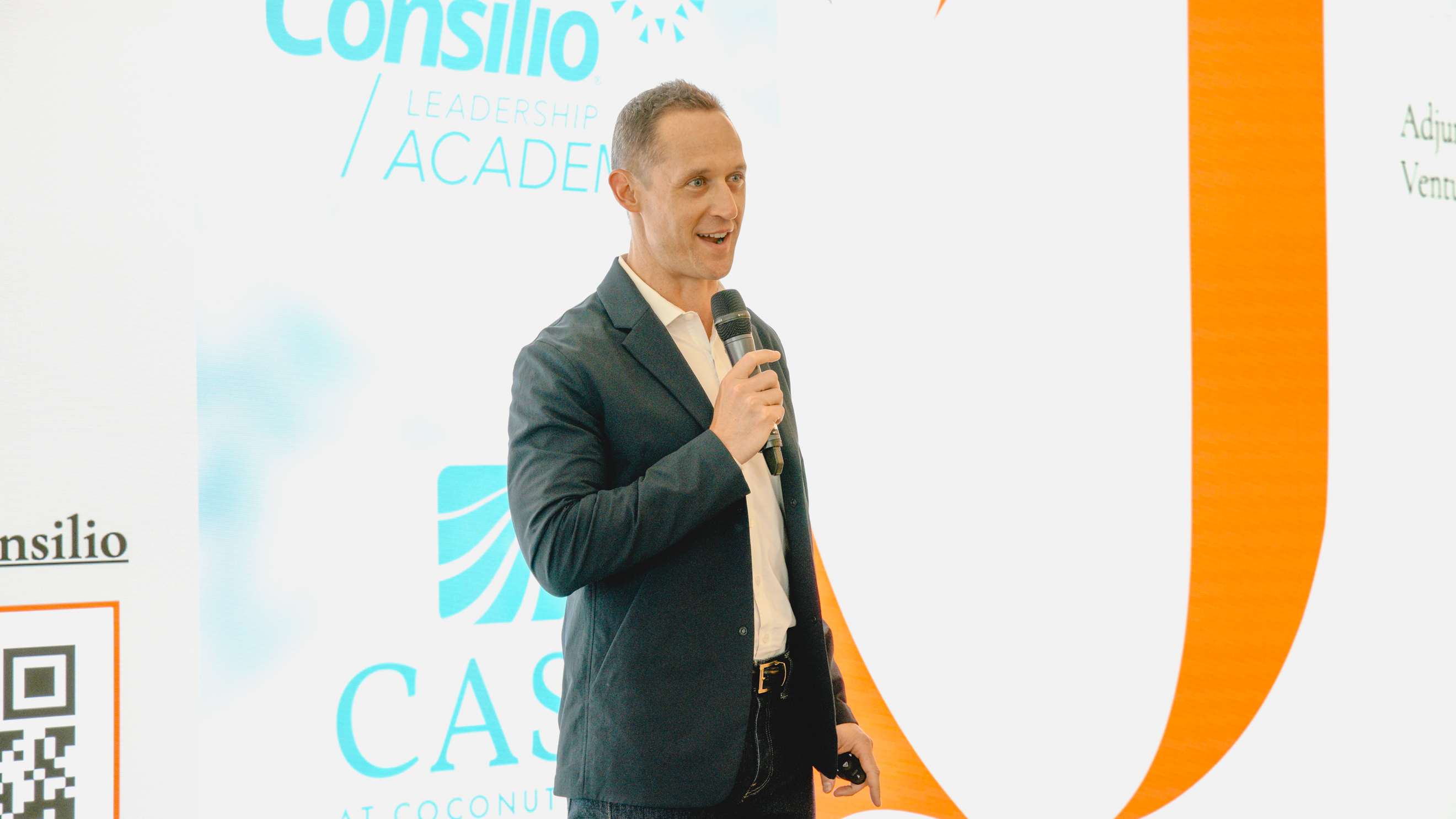
At our Consilio Leadership Academy graduation one of the speakers was Jeremy Utley, a professor at Stanford who teaches innovation and has become one of the leading voices on AI adoption for non-technical leaders.
What he said changed how one might think about experimentation.
He talked about a recent MIT study showing that 95% of AI projects fail. The headlines were everywhere: "See? AI doesn't work!" But Jeremy reframed it completely. He said: That's not an AI problem. That's an innovation problem. Innovation projects have always failed at that rate. We just forgot.
He introduced a concept he calls "updating your priors" — the statistical reality that if you expect 95% failure, you need 10 to 20 times more attempts than you think. Not 10 to 20 percent more. Times.
And then he shared something that hit even harder. He quoted Paul Nurse, a Nobel Prize-winning biologist and CEO of the Francis Crick Institute:
"I have run a laboratory for nearly 50 years and half my time, I'm just an amateur psychiatrist to keep my colleagues cheerful when nothing works. And quite a lot of the time, I mean 80 to 90% of the time, it does not work. If you are at the forefront of science, I can tell you, you will fail a great deal."
Half his time. Keeping people cheerful. Because nothing works.
That's the part nobody talks about. If people don't realize that failure is part of the process, they see early setbacks as evidence that they should stop. Those setbacks are not signals. They are data.
The Simultaneity of Arrivals
There's a concept from the organizational theorist Jim March called the "garbage can theory of innovation." The idea is that great innovations often happen when disparate ideas land in a receptive mind at the same time. He calls it "the simultaneity of arrivals."
That's what happened here.
The hands-on imperative. The novice perspective. The failure-is-normal framework. Three ingredients, arriving at the same time.
What We Built
We realized something important. Consilio already has infrastructure approved to host data for our clients. We’ve bonded through our governance process. The clients can already do things on our systems.
So why don't we create a playground for them?
With this background, we launched what we now call the Consilio Innovation Lab, a space where clients can try dozens of early-stage technologies using synthetic data sets designed to mirror their real problems. No vendor risk. No year-long onboarding. No RFPs.
Just experimentation. And in doing so, the conversation changes. Speculation turns into evidence, and teams are given something concrete to advocate for within their organizations.
A client facing an internal investigation about embezzlement? We can model that fact pattern with synthetic data, and they can test five different AI tools to see which one actually works for their needs. They learn by doing, not by reading proposals.
And here's the key: it's OK if none of them work. That's not failure — that's information. That's updating your priors.
Before our first event, we showed the clients a clip from Jeremy's CLA talk. We wanted to set their mindset before they walked into a room full of startup founders pitching ideas. We told them: You're about to see a hundred different early-stage companies. Here's why. Because this is the level of experimentation required to find what actually works.
When we came back for the roundtable discussion, the enthusiasm was palpable. These were people who had been locked in a box. If it doesn't bolt onto Oracle, we can't try it. Suddenly they were seeing founders with fresh perspectives and technologies they'd never have access to otherwise.
The Innovation Lab was born from that energy.
What we are Bringing to the Marketplace
With technology, particularly AI, advancing in cycles that do not align with traditional enterprise evaluation timelines, it is essential to take advantage of every opportunity to experience new solutions as early and as deeply as possible. If the Lab helps clients get in early, get oriented, and decide what is truly worth fighting for internally, then we have done something meaningful.
The alternative is captured in something I heard a CIO say recently about a leading AI technology: "I pay too much for it to not work."
When you've invested a year in governance approvals and significant money in a contract, you can't afford to admit something doesn't work. We understand the instinct, but that's exactly backwards. We’re doing the opposite by eliminating the cost of finding out if something won’t work.
Simon Sinek once said something that I think about a lot: "The difference between a startup and an enterprise is this: A startup's ambitions exceed its grasp. An enterprise's ambitions lie within its grasp."
Most enterprises have stopped reaching for things they might not achieve. They've become comfortable with achievable goals.
The Innovation Lab is our attempt to change that. We want to enable them to experiment at scale, with minimal friction, and with explicit permission to fail.
And the impact goes far beyond these particular clients – all of Consilio’s teams and clients benefit from the access and experience Consilio fosters through this structured access to the best early-stage innovation.
Closing the Loop
We reached out to Jeremy recently to thank him and to suggest we tell this story together. He told us something that stuck with us: in his work as a professor, author, and speaker, very few people close the loop. Very few come back and say, "The thing you taught me actually resulted in something."
So we wanted to close the loop.
Jeremy: your talk was one of three ingredients in one of our best ideas. You helped us update our priors. You helped us give clients permission to fail, which it turns out was exactly what they needed.
