Women In Technology - Krystal Studavent Ramsey
-min.jpg)

Krystal Studavent Ramsey serves as Consilio’s Director of Diversity, Equity, and Inclusion. She is an award-winning diversity, equity, and inclusion leader, legal business development strategist, legal talent innovator, and attorney with 17 years of experience in the legal industry. Her expertise includes legal business and talent growth strategy development and implementation, client development, talent management, cultural change management, cross-functional integration, solution identification and advising, managing strategic partnerships, communications and modernizing operations. Through her leadership, she has driven revenue and market growth, impact, and innovation.
How did you get into this industry?
Immediately after law school, as I was trying to figure out what path I wanted to take, I tested the waters in legal technology and consulting by working for Huron Legal as an associate. I focused on eDiscovery consulting, developing recommendations that enhanced the efficiency and productivity of legal departments, including workload, cost, structure, reporting, processes, workflow, and technology leverage, and benchmarking against industry best practices. Eventually, I decided to take the corporate M&A route and went to practice at a boutique corporate firm in Houston, Texas.
My return to legal tech represents the shifts in the legal market, my passion for innovation and harnessing technology to improve client and employee experiences, and the natural evolution of my career, culminating in multidisciplinary experience spanning the intersection of law, diversity, equity, and inclusion, business growth strategy, client development, legal consulting, and innovation. In my leadership roles at AmLaw 100 firms, I was on strategy and transformation committees, supporting rollouts for platforms such as Onit, HighQ, Okta, and Contract Express. This experience helped me gain a deeper understanding of how legal technology provides scalability, efficiency, and maximizes value.
What were some of the pivotal moments in your career that helped shape your journey?
“A queen of reinvention,” some have said. There have been several pivotal moments that have shaped not only my career but also my leadership philosophy and approach. The first was serving as General Counsel and Senior Vice President, Business Affairs of Music World, an entertainment conglomerate affiliated with Beyoncé and BET Sunday Best, which helped shape me as a leader early in my career. I was the youngest person to serve in this role, and it was the first time I owned a P&L, led a large team, and managed a growth strategy for a conglomerate that was expanding its global footprint, rebranding in the marketplace, transitioning technologically, streamlining its operations, and growing in the digital environment. I loved that experience because I learned a lot about business growth in a fast-paced environment, and my achievements were recognized and rewarded.
The second would be breaking into BigLaw leadership, which would provide a foundation in client development and management. I led business development strategy, supporting several litigation and compliance groups, and served as the U.S. lead for diversity, equity, and inclusion at a global law firm, working closely with the U.S. Diversity & Inclusion Committee. This gave me a front-row seat to the strategic growth drivers for global law firms, as well as a deeper understanding of how they retain clients and position themselves competitively. I developed relationships and was mentored by several firm leaders, which sharpened my leadership skills.
The third would be serving as the first, dedicated diversity, equity, and inclusion leader for an AmLaw 100 firm, building the function from the ground up. This opportunity was special because it allowed me to merge my passions, advance my purpose, and leverage my diverse and unique experience in business development, growth strategy, diversity, equity, and inclusion, as well as talent consulting, to deepen client relationships, unlock revenue opportunities, improve employee experiences, and enhance the culture. That insight positioned me to build bridges between law firm leadership, clients, and our people.
The fourth would be me becoming an entrepreneur, launching a legal business growth and talent strategy consulting company, which was the pathway that led me to Consilio.
The last would be me serving in community impact leadership and thought leadership roles for organizations such as Forbes, the Diversity Attorney Pipeline Program, the Downtown Group, the National Bar Association, the Houston Association of Women Attorneys, the Houston Bar Association, the State Bar of Texas, and the Texas Membership Connections Program (TMCP). This helped me expand my network, mentor emerging leaders, build a thought leadership platform, drive positive change in the legal industry, and give back to the community.
Have you ever experienced moments where your gender played a role in your career?
Absolutely. Facing multi-marginalization, being an African American woman who is in her 40s, that attended an HBCU and has had an unconventional and non-traditional legal career, I have been undermined, undervalued, underutilized, underappreciated, and underestimated by men and women, with barriers in some workplaces and the intent from some to see me fail. These experiences helped shape who I am and taught me the importance of owning my voice and career journey, cultivating a community, learning and being able to articulate my value with clarity, ensuring my contributions weren’t invisible, and to appreciate that my various traits and experiences serve as strengths in both my professional and personal life, guiding me and helping shape my decisions, and adding value and new perspectives at work and at home.
It has also been a superpower that has given me essential context when I have led women-focused organizations and groups. Because I have experienced firsthand what it feels like to navigate bias and stereotypes, I bring empathy, strategy, and practical solutions to help other women elevate their voices, develop their skills, advance their careers, and drive change in spaces where they may be overlooked and underrepresented.
What advice would you give to someone working in a predominately male workplace?
I would first say, figure out who you are – learn what your unique value is and own it everywhere you go. Be very intentional about the expertise you bring to the table and articulate it confidently and unapologetically. Don’t downplay or dilute your accomplishments – share them and understand how they contribute to the organization’s success.
Secondly, I have learned a lot from men and women in the various workplaces I have been in. So, build, relationships with women and men in and outside the organization. You need a well-rounded network, so don’t be shy to develop a network of authentic mentors, sponsors, and advisors across genders who will contribute to your development, advocate for you, help you see blind spots, present growth opportunities, and help shape your career. Equally important is building networks with other women from diverse backgrounds. There is power in a multifaceted community.
Third, put your voice in the room. Don’t let your voice and ideas be overshadowed. Speak up for yourself, use data to back your perspectives and get buy-in for your ideas, and practice confident communication. Coaching helps with this if you can’t do it on your own. How you show up in the workplace matters just as much as substance.
Fourth, set boundaries and advocate for yourself. Track your own achievements and progress. Don’t shy away from making a business case and advocating for promotions, raises, and growth opportunities, backed by evidence of your performance. Use performance reviews and check-ins with your managers to discuss what you want. Be proactive in sharing your goals. This is strategic for your career journey.
Fifth, be an inclusion champion. Some women may have better experiences in these environments than others for various reasons. Everyone should strive for an inclusive environment that harnesses the power of diversity to drive innovation, facilitate better decision-making, and foster growth.
Sixth, play a long game. We all want to thrive in the workplace. Focus on building credibility, developing your skill set, being results-oriented, and opening the door for the next generation.
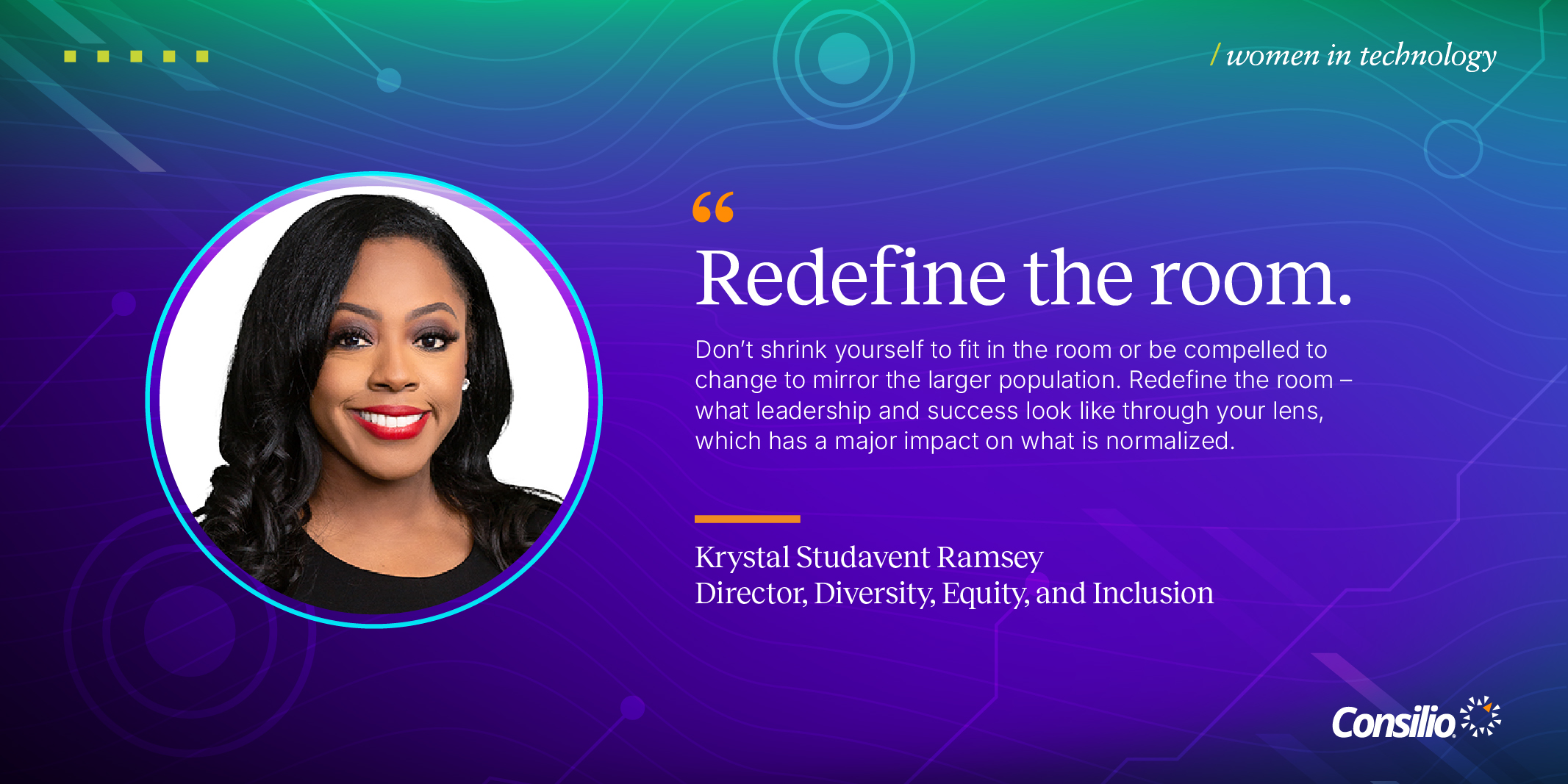
Lastly, don’t shrink yourself to fit in the room or be compelled to change to mirror the larger population. Redefine the room – what leadership and success look like through your lens, which has a major impact on what is normalized.
What do you think companies could do to motivate more women to pursue careers in technology?
Despite decades of incremental progress, women, especially women of color, remain significantly underrepresented in technology – especially in leadership and technical roles – globally. The barriers aren’t about talent, ambition, drive, or interest. They are related to a lack of access, visibility, culture, opportunity, development, stereotypes, profiling, pay gaps, work-life integration challenges, existing policies that are not centered around well-being, and a lack of genuine sponsorship. If companies want to drive change, they must be more intentional and address challenges and gaps beyond just recruitment, through an intersectional lens, recognizing that women from diverse backgrounds face different experiences and challenges in the workplace. They must audit the full talent lifecycle, evaluating how women are developed, promoted, supported, compensated, and if they are advancing.
Below are five meaningful ways that companies could begin this work to get more women to pursue careers in technology:
1) Start early by building a pipeline sooner. Exposure is very important, and the sooner girls have it, the better positioned they are. Many girls don’t envision themselves in technology careers because they aren’t introduced to coding, AI, engineering, cybersecurity, data privacy, tech sales, tech consulting, and other related fields until perhaps college, if at all. Companies should:
- Partner with middle schools, high schools, colleges, HBCUs, HSIs, and nonprofits to fund and sponsor tech programs and innovation labs.
- Provide certifications for programming so students can begin building out their portfolio early.
- Hosting “career days in tech” events where women engineers and leaders in technology share their career journey.
- Offering scholarships, internships, and mentorship that create real, tangible access to opportunity.
2) Fix the entry channel by rethinking and redesigning hiring and sponsorship workflows. Women are often screened out. Bias shows up, overtly and covertly, emphasizing masculine stereotyped traits, such as considering years of experience/seniority over output and skill set, and favoring aggressiveness over empathy because of societal grooming. Interview panels often lack diversity in various dimensions, and that needs to change. Companies should:
- Review and rewrite job postings regularly, being sure to use inclusive language that embodies the values of the organization.
- Train recruiting professionals, talent acquisition teams, and hiring managers to recognize bias and favoritism in recruiting and hiring.
- Have interviewer panels that reflect a broader talent pool to help bring perspective to nuances.
- Standardize hiring practices for consistency and inclusion.
- Move beyond just mentoring and layer with genuine sponsorship – having executive and senior leaders advocate for high-performing women in meaningful ways, creating pathways and giving access to high-stakes and high-growth opportunities.
3) Create cultures that retain and elevate women. Recruitment without retention is a revolving door and a recurring issue. Research shows that many women leave technology roles mid-career due to stagnation and exclusionary cultures, lack of flexibility, and slower advancement in comparison to men in the same roles, and largely not because of performance or a lack of ambition. Companies can:
- Make flexible and hybrid work models standard and not stigmatized.
- Evaluate their compensation structure and ensure pay equity and promotion parity.
- Embed inclusion as a business performance metric and accountability measure for leaders.
- Create and implement policies that promote well-being and wellness, family and financial planning, and address women’s needs holistically.
- Offer benefits that are meaningful and address the front-of-mind needs for women.
- Create leadership pathways and opportunities for women to develop their leadership skills and position them for elevation.
- Introducing women to high-powered, informal connections and social experiences can increase their influence, which is frequently closed off to women.
4) Showcase women in leadership and innovation.
- Representation isn’t just symbolic – it’s magnetic. When women see other women thriving in an organization and in leadership, making and implementing decisions, they know what is possible in that organization.
- Companies should be intentional about developing women leaders and technical experts.
- Spotlight their stories at conferences, summits, in the media, at Town Halls, and to clients. Make women visible in the innovation and sales pipeline, currently dominated by men, and not just in support and administrative functions.
- Nominate women for reputable awards and recognize them for their contributions, which are often well-rounded (e.g., technical, social, strategic).
5) Connect inclusion to innovation. The conversation about barriers for women in tech isn’t new. It isn’t a conversation that is solely about fairness; it is also essential for innovation and growth.
- Many business and legal leaders I speak with believe that diverse teams and perspectives lead to better and richer insights, products, services, creative problem-solving, added value, and the ability to address the needs of a broader client base more effectively.
- Companies that can demonstrate and articulate how diversity, equity, and inclusion and innovation are integral to their value proposition will have more of a competitive advantage. These companies can attract more women to technology careers and better address more of the needs of their clients, ultimately having a meaningful impact.
If companies want to inspire more women to pursue careers in technology, they must stop treating it as a numbers game and gain a deeper understanding of the pervasive and persistent barriers through different lenses, incorporating this tenet as part of their inclusive growth strategy. Women play a critical role in shaping the present and future of technology.
-min.avif)


