
From Expert Systems to Generative AI: The Evolution of AI in the Legal Industry
.jpg)
-min.jpg)

Artificial intelligence may feel like a recent development within the legal profession, but its roots extend back more than 50 years. Long before generative AI captured headlines, researchers, technologists, and legal professionals were exploring ways to use AI and computers to support legal reasoning, analyze documents, and improve decision-making.
Over the decades, legal AI has progressed through several distinct phases. Early systems focused on applying legal rules to specific scenarios. As computing power increased and digital information expanded, new technologies emerged to help legal teams manage growing volumes of documents and data. Machine learning introduced more sophisticated approaches to document review and legal analytics, while advances in natural language processing made it possible for software to better understand and organize legal language. Today, generative AI is accelerating many legal workflows and building on decades of technological innovation.
The history of AI in the legal industry is not a story of steadily improving technology. Each major advancement introduced new capabilities, but widespread adoption depended on the profession developing the workflows, governance, infrastructure, and confidence to use those capabilities responsibly. From expert systems to predictive coding and today's generative AI, legal teams have repeatedly experienced the same pattern: technology advances first, while trust and operational readiness take longer to develop.
Understanding this history provides valuable context for today's legal professionals. It demonstrates how AI has evolved alongside changing legal practices, growing data volumes, and rising business expectations.

The 1970s: The First Legal Expert Systems
The earliest work on legal artificial intelligence began in universities during the 1970s. Researchers explored whether computers could assist with legal reasoning by applying predefined legal rules to factual scenarios.
These early applications, known as expert systems, relied on decision trees and "if-then" logic to reach conclusions. Instead of learning from data, they followed structured rules developed by legal experts.
One of the best-known examples was TAXMAN, developed by Professor L. Thorne McCarty in the United States. Designed to analyze corporate tax law, TAXMAN demonstrated that computers could model certain forms of legal reasoning within highly structured legal domains.
Although legal AI research remained largely confined to universities, the broader legal technology market was beginning to change. In the early 1970s, Mead Data Central launched the LEXIS legal research service, giving lawyers electronic access to the full text of New York and Ohio statutes and case law, the U.S. Code, and federal tax materials. West Publishing introduced Westlaw in 1975, creating the first major competition in computer-assisted legal research. This provided a new electronic research option alongside traditional methods, and over time transformed how legal research was conducted. By digitizing case law and allowing lawyers to search documents using early text, keyword, and basic Boolean queries, these services helped pioneer computer-assisted legal research (CALR) databases.
Both platforms predated the internet and operated through dedicated dial-up terminals. At the time, many questioned whether lawyers would ever embrace electronic legal research. Some predicted these services would threaten traditional law book publishing, while others believed there simply was no market for computer-assisted legal research. Those concerns would eventually give way as digital legal research became standard practice across the profession.
Although computing power limited the practical use of these early systems, it was also the start of many of the concepts that continue to influence legal AI today, including knowledge representation, legal reasoning, and decision support.
Although these systems demonstrated that legal reasoning could be partially automated, maintaining thousands of manually created rules proved expensive and difficult. The technology showed promise, but the supporting infrastructure and practical maintenance required for broad commercial adoption had not yet matured.
The 1980s: Knowledge-Based Legal Systems
During the 1980s, expert systems became more advanced as researchers developed larger legal knowledge bases covering specific areas of law.
As expert systems gained momentum across the broader AI industry, legal AI experienced a period of rapid innovation. Researchers explored other approaches to legal reasoning.
In 1986, the British Nationality Act was encoded as a logic program using Prolog, demonstrating that complex legislation could be represented in a machine-readable format. The following year, Richard Susskind published Expert Systems in Law, helping establish the field's academic foundations, while Kevin Ashley's HYPO introduced case-based reasoning, allowing computers to analyze legal arguments by comparing judicial precedents instead of relying solely on predefined rules.
The first International Conference on Artificial Intelligence and Law (ICAIL), also held in 1987, marked legal AI's emergence as a recognized international research discipline. By 1988, the Latent Damage System, developed by Phillip Capper and Richard Susskind, became one of the first commercially available legal expert systems in the United Kingdom, demonstrating that these technologies were beginning to move beyond universities and into legal practice.
Commercial adoption remained limited, largely because maintaining rule-based systems required substantial effort. As the decade came to a close, many expert systems also proved difficult to scale and adapt as laws evolved.
Combined with growing skepticism across the broader AI industry, these challenges contributed to the "AI winter," when funding and commercial enthusiasm for expert systems declined sharply. Even so, this period demonstrated that technology could support legal professionals beyond simple document storage and laid the foundation for future generations of legal AI.
The 1990s: Digital Documents Transform Legal Practice
The widespread adoption of personal computers fundamentally changed how legal work was performed.
Law firms and corporate legal departments transitioned from paper files to electronic documents, email became an essential business communication tool, and digital records grew rapidly across companies.
Legal technology companies responded by developing document management systems, litigation support software, and electronic databases capable of storing and searching growing collections of legal information.
While rule-based expert systems declined following the AI winter, legal AI research continued to evolve. Researchers explored machine learning, natural language processing, information retrieval, and automated text classification as alternatives to manually maintained rule sets.
For example, advances in information retrieval and natural language processing helped improve legal search by enabling systems to rank documents based on relevance instead of relying solely on exact keyword matches. Rather than attempting to encode every legal rule, these approaches focused on identifying patterns within growing collections of digital legal documents.
Although computing power, data availability, and algorithms were not yet mature enough for widespread commercial adoption, this shift laid the groundwork for many of the technologies that would later power eDiscovery, legal search, predictive coding, and generative AI.
Artificial intelligence played only a limited commercial role during this decade, but legal AI research shifted toward data-driven approaches. At the same time, the rapid digitization of legal information created the data foundation that would enable the next generation of AI-powered legal technologies.
The 2000s: The Rise of eDiscovery and Analytics
As email volumes increased and electronically stored information became central to litigation, legal teams faced an unprecedented challenge: reviewing millions of digital documents efficiently while meeting court deadlines and regulatory obligations.
The legal technology industry responded with increasingly sophisticated eDiscovery platforms that combined advanced search capabilities, data processing, and analytical tools.
Concept searching, email threading, near-duplicate detection, and early analytics helped legal professionals prioritize review efforts and identify relevant information more efficiently than traditional keyword searches alone. This period also marked an important shift within the courts. As electronically stored information became a standard component of litigation, judges began to expect parties to implement defensible processes for preserving, collecting, reviewing, and producing digital evidence. On December 1, 2006, amendments to the Federal Rules of Civil Procedure took effect, marking a critical shift in legal practice by formally recognizing electronically stored information (ESI) as a central component of the discovery process. The changes established new expectations for how organizations handled the identification, preservation, and production of digital records.
While these technologies improved the speed and scale of discovery, they also introduced new challenges for legal teams. Analytical capabilities evolved faster than the profession's established workflows, leaving businesses to determine how these tools should be validated, documented, and defended. Lawyers needed confidence that technology-assisted decisions could withstand judicial scrutiny, while clients expected greater efficiency without increased risk.
As a result, businesses invested in both new platforms and the review protocols, quality control measures, and governance frameworks, needed to support the responsible use of analytics.
The Early 2010s: Predictive Coding Changes Document Review
One of the most significant developments in legal AI came with the emergence of predictive coding, also known as Technology Assisted Review (TAR).
Unlike earlier rule-based systems, predictive coding used machine learning to identify documents likely to be relevant based on examples reviewed by experienced attorneys.
Instead of reviewing every document manually, legal teams trained algorithms using sample sets of responsive and non-responsive documents. The software then ranked the remaining documents according to their likely relevance, allowing reviewers to focus their attention more efficiently.
Court decisions in both the United States and the United Kingdom recognized predictive coding as a defensible review methodology, encouraging broader adoption across large-scale litigation and regulatory investigations.
Predictive coding demonstrated how machine learning could support legal review while maintaining quality and consistency when combined with appropriate legal oversight.
The Late 2010s: AI Expands Across Legal Operations
As machine learning matured, AI capabilities expanded beyond litigation into many areas of legal operations.
Contract analysis platforms began extracting clauses automatically from agreements. Due diligence tools accelerated transactional reviews. Compliance solutions monitored regulatory developments, while legal research platforms introduced AI-assisted search capabilities that helped attorneys identify relevant authorities more efficiently.
Natural language processing also advanced considerably during this period. Instead of relying primarily on keywords, legal software became capable of understanding legal terminology, recognizing entities, categorizing documents, and identifying relationships between concepts.
Many businesses began incorporating AI into everyday legal workflows while continuing to rely on legal professionals to validate outputs and apply legal judgment.
As legal teams became more comfortable with data-driven technologies, the role of analytics expanded beyond document review. Organizations began using technology to identify patterns across large datasets, improve information governance, and support earlier case assessment. These developments changed expectations around how legal teams approached large-scale investigations and created the foundation for more advanced AI applications in the years that followed.
The 2020s: Generative AI Accelerates Legal Work
The modern era of generative AI began in the early 2020s, driven by advances in large language models (LLMs) trained on vast collections of text. While models such as GPT-3 demonstrated the technology's potential in 2020, generative AI entered the mainstream with the public release of ChatGPT in late 2022. Its ability to generate text that appears human-like, summarize complex information, draft documents, and answer natural language questions quickly, attracted attention across the legal industry.
Generative AI applications now assist with drafting correspondence, summarizing documents, analyzing contracts, preparing research summaries, generating first drafts, organizing information, and supporting knowledge management initiatives.
Legal software vendors have rapidly integrated generative AI into existing platforms, while many businesses are developing governance frameworks to guide responsible adoption.
At the same time, legal departments continue evaluating how generative AI fits alongside established technologies such as document management systems, contract lifecycle management platforms, eDiscovery software, and legal operations tools.
The growing interest in generative AI represents the latest stage in a much longer history of legal technology development. Today's innovations build upon decades of progress in data management, machine learning, analytics, and natural language processing.
What the Evolution of Legal AI Tells Us
Looking back across five decades reveals several consistent themes.
Legal AI has evolved in response to changing business needs, expanding data volumes, advances in computing power, and growing expectations for efficiency. Each generation of technology has addressed different operational challenges while building upon earlier innovations.
The progression from rule-based reasoning to machine learning, natural language processing, predictive analytics, and generative AI illustrates how legal technology has become more capable of supporting a broader range of legal activities. Throughout that evolution, legal professionals have continued to provide the legal expertise, strategic judgment, and professional accountability that technology complements.
Understanding the history of AI provides a useful perspective as businesses evaluate emerging AI capabilities. Many of today's innovations represent the continuation of a long period of technological advancement that has gradually reshaped legal practice over several decades.
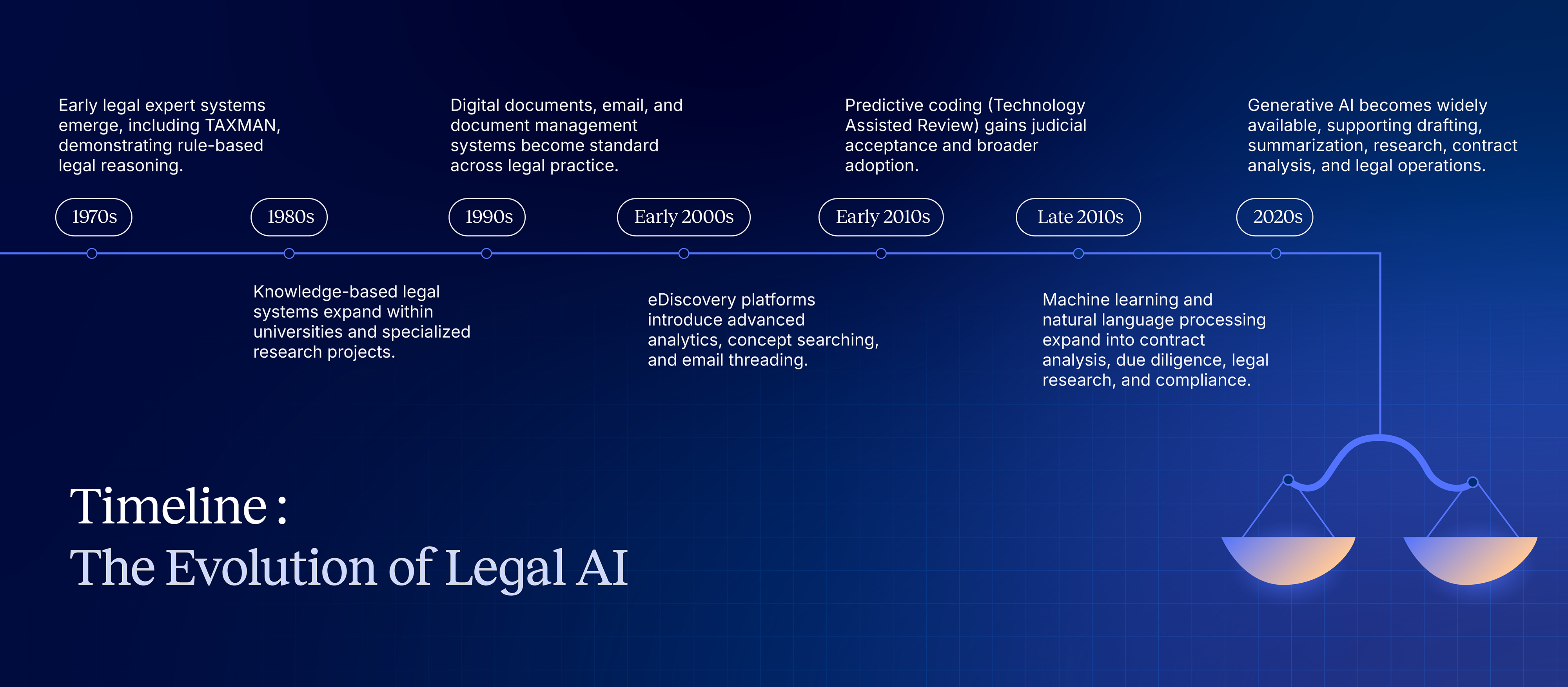
Timeline: The Evolution of Legal AI
Artificial intelligence continues to evolve, and its role within the legal profession will continue to expand. Looking back at its history shows that today's developments are part of a decades-long progression of innovation that continues to reshape how legal services are delivered, supported, and improved.
